ABOUT THE BOOK
How To Frame A LifeA gentle map to living a life of grace, joy and love in turbulent times. Lucinda Kang | The Rest | ISBN: 978-1-919339-10-8
How To Frame A Life is not a self-help book. It does not promise transformation, offer a five-step framework, or tell you that everything happens for a reason. What it offers instead is rarer: honest company in the dark, and a quiet invitation to see differently.
Written in the aftermath of a seven-year psychologically challenging relationship, Lucinda Kang's debut work is part memoir, part philosophical anthology, part curated companion — a book designed to be used, not just read. Its central argument is elegant and hard-won: that the frames through which we perceive our lives — our thoughts, our habits of attention, our inherited stories — are not fixed. They can be examined, questioned, and changed. Not easily. But deliberately.
The book is built around a governing metaphor: the window. Our eyes, ears, and minds, Lucinda writes, are like windows. The frame determines what we see and what we don't — and those frames become either our prison or our portal. How To Frame A Life is an invitation to notice which one yours has become.
Structured as a "library pharmacy" — to be read in one sitting, dipped into at random, or navigated by need — the book moves across four sections, each approaching life through a different lens: The Overview Effect (the cognitive shift that comes with stepping back and seeing the bigger picture), The Infinite Game (living relationally rather than transactionally), The Radical Commons (love, community, and shared humanity as a framework for survival), and An Unpopular Movement (love as an act of courage, not a feeling to be managed).
Throughout, Lucinda weaves her own raw diary entries alongside the words of thinkers and writers who have shaped her — James Baldwin, Rebecca Solnit, Jeanette Winterson, Viktor Frankl, Khalil Gibran, Paulo Freire, and many others — not as decoration, but as medicine. Precisely dosed. Carefully chosen.
How To Frame A Life is for anyone who has ever tried to hold beauty and sorrow in the same hand. For those healing from love, from loss, from the quieter devastations of feeling unseen. For people in midlife asking hard questions about identity and choice. For anyone who is tired of being sold toxic positivity — and ready for something that tells the truth.
"Healed is not a destination. But if we are willing to pull back, look up, look around, look within, we might begin to see more that has nothing to do with our suffering — that we can have enjoyment in spite of our suffering." — Lucinda Kang, How To Frame A Life
Key Details
Format: Print and Digital Publisher:
Available at The Great British Bookshop and www.howtoframealife.com
Hardcover. Size: 6 × 8 (Full Colour)
ISBN: 978-1-919339-10-8
Available at: Amazon
Hardcover. Size: 6×9 (Full Colour)
ISBN: 1919339124
Paperback: Size 6×9 (Black and White)
ISBN: 979-8247710011
Available at: Barnes and Noble
Hardcover. Size: 6×9 (Full Colour)
ISBN: 9781919339122
Paperback. Size 6×9. (Black and White)
ISBN: 9781919339115
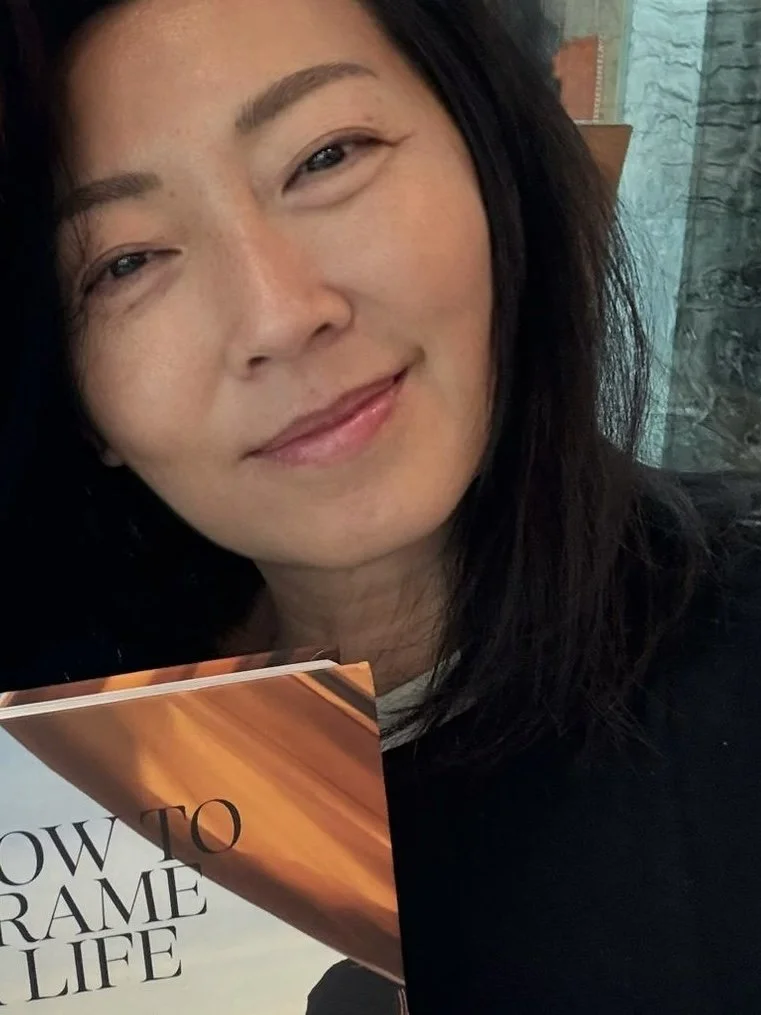
About The Author
Lucinda Kang writes at the intersection of the soul and the world. She is drawn to the questions that don't resolve neatly — about love, grief, identity, and what it costs to stay open when life has given you good reason to close.
Her first book, How To Frame A Life, was born from one of the harder seasons of her life: the aftermath of seven years in a psychologically abusive relationship, navigated at 58, in the middle of an already peripatetic existence. It is not a book about surviving. It is a book about noticing — the small, stubborn evidence that joy and sorrow are not opposites, that healing is not a destination, and that the frames through which we see the world are always, quietly, available to be changed.
Lucinda grew up in Singapore and has since lived across three continents, spending formative years in cities that shaped her — and asked her to reshape herself. She is a former stay-at-home mother who raised a son she describes as her wisest counsel and one true love, now watching him build his own life in Shanghai. She knows what it means to build an identity around someone, and what it means to have to find it again when they leave — not through loss, but through the bittersweet, necessary business of loving well.
Her writing draws widely: from Simone Weil and Viktor Frankl to Jeanette Winterson and James Baldwin; from the Overview Effect to Ubuntu philosophy; from her mother's extraordinary mythology — orphaned, sold, and self-made by seventeen — to the raw pages of her own diary. She curates not to perform erudition, but because she genuinely believes words are medicine, and has spent years collecting the doses that worked.
She is the founder of The Commons and The Rest & Play — a philosophy and creative community built on the premise that we understand what we choose to notice, and become what we choose to do with it. It is, she says, a home for restless souls.
Lucinda lives between cities and inner landscapes, always drawn to the in-between. She is currently working on her next book.